It’s winter, 1993, late at night in Pietermaritzburg. I’m returning to a small hotel on the edge of town, where my family are all sleeping, my parents, brother and sister, after a long day of schoolboy rugby.
My younger brother has been the day’s hero. The day has been full, it feels done.
Animated faces from the day’s action have left residues in my brain, and I’m relishing the prospect of a warm bed and a hotel breakfast in the morning.
I get out of my car as three men approach, from a minibus on the other side of the road. They’re not threatening. What do they need?
They tell me they’re looking for… a judge? Yes. Well, I can’t help them. They hand me a piece of paper.
It has some typed information on it in Zulu, and a fresh SAP ink stamp with today’s date.
I slowly realise that they want me to be a judge for them. What kind of judge? A judge of what?
They seem desperate, exhausted. Like they’ve been waiting a long time. It must be after 1am. They want me to come with them. Come, they say. Please come.
And so, I decide to go. And head off in the opposite direction to the warm bed. Maybe I’m thinking I’m going to be useful, that I’m needed for something beyond my comprehension. And that it might make me feel good.
Maybe I feel I don’t have a choice in the matter. Maybe this is bigger than me. I don’t know.
Well then, one of you must ride with me, I say. To show me the way. No. We can’t come with you. You follow us.
And so, I follow, wondering what on earth I’m doing driving into Edendale township in the early hours of a Sunday morning, following a group of perfect strangers.
After a drive, we approach what seems to be a tavern, teeming with people. It has a second floor, a staircase up the outside of the building.
I ask one of the men if this is where we’re going, or perhaps I asked something else, I can’t remember, but he doesn’t want to talk to me. No one does.
People are avoiding me, like I have the plague. I’m aware that no one on God’s wide earth knows where I am. These are the days before cellphones. But really, what’s the worst that can happen?
I enter a large room. It’s packed full of people, seated in rows, young and old, hundreds of people. They’re tired. They perk up when they see me.
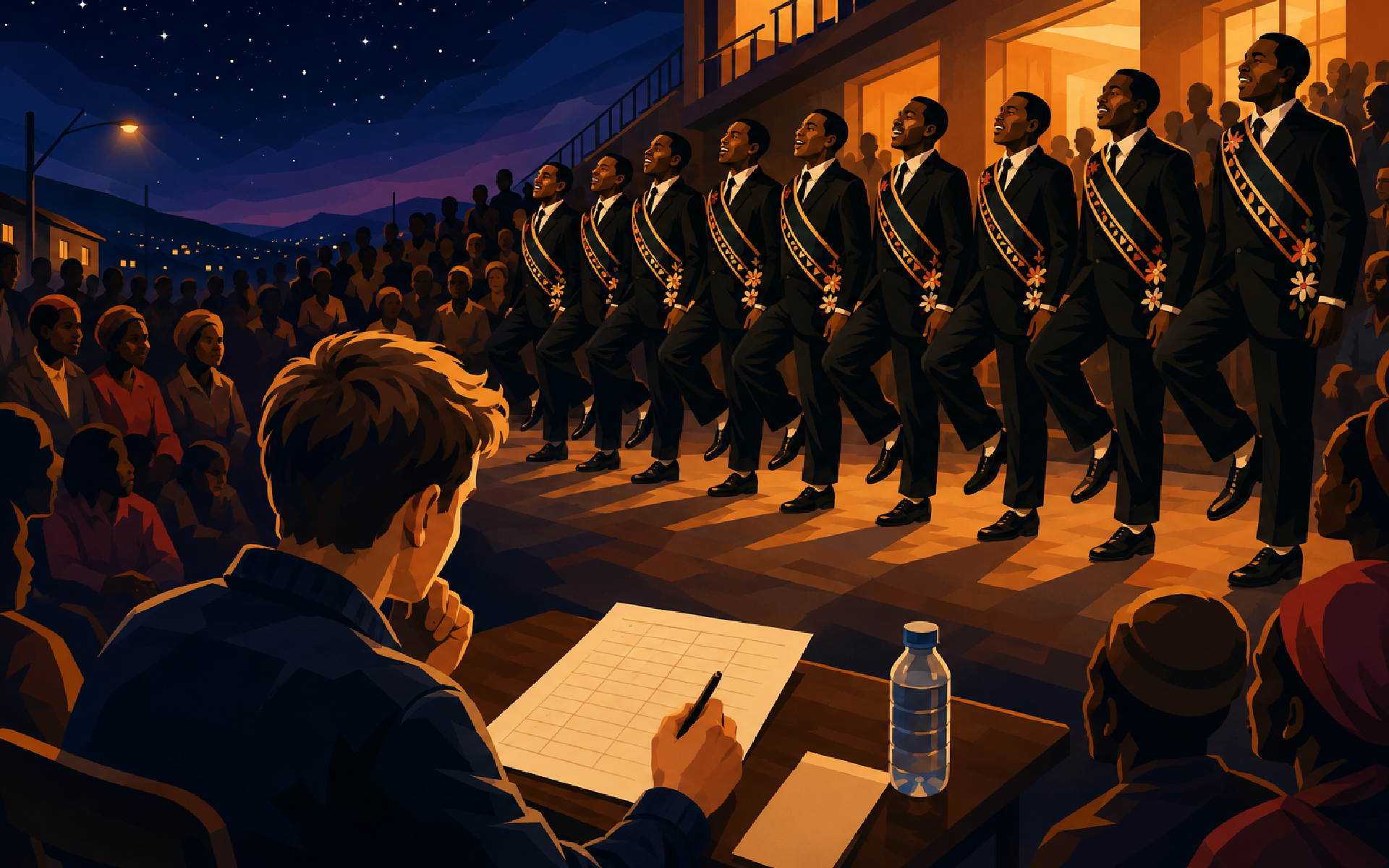
There is a table in the front of the crowd, facing an open space. This is where I must sit. This is where I will be a judge. What do you need, I’m asked. Paper, a pen, some water. It all duly arrives.
What happens next takes my breath away. It stops the stars in the heavens, and makes them spin briefly the other way.
What happens next is experienced by me alone, despite my burning desire to share what I’m experiencing with someone, anyone.
A group of men emerge in a straight line from the door in the corner. They are dressed in black suits, with beautiful hand-stitched sashes across their chests proclaiming themselves the “Isipingo Washing Boys”.
They are arranged shortest to tallest, about nine men. They smile at me, and then burst into song. And they dance.
I am the judge at an isicathamiya contest. The word, as I later find out, is Zulu for “to walk like a cat,” referring to the slow, carefully choreographed steps and tap dance movements that accompany the singing.
It is a close harmony acapella style, developed by Zulu migrant workers about a century ago in the coalfields of Dundee, Vyrheid and Newcastle in the Natal Midlands. Ladysmith Black Mambazo are probably its most famous exponents.
But here I am now, as group after group serenade me, giving it all they have. I realise I have been plucked off the street because of my assumed impartiality.
They move around me like silk, like smoke, mesmerising. Each group sings about three songs.
I’m making notes. I’m embarrassed, a little, by my power to decide. But I’m taking my responsibility seriously.
I’m wondering when it will end. Perhaps I pause to question my credentials. I’m just a kid, really.
These people, the singers and the audience, have travelled from all over, from Richard’s Bay, Inanda, KwaMashu, Howick and Ixopo (which means, in Zulu, the sound of a cow pulling its hoof out of the mud, incidentally.) I drove here in my mom’s old car, diverted.
I marvel at this moment, this country, this town, at its complexities, at its scars and dreams and catastrophes and its love.
I seem to have found one of the universe’s fleeting sweet spots. Why me? Some divine hand has placed me here.
I think how I could have said no, and walked off, selfishly. How I could have veered away while I was following the minibus.
My fear of the unknown, of a township at night, of the violence of Pietermaritzburg in the early 90s could have put me off.
I could have chosen safety, bland sleep, the prospect of scrambled eggs and sad tomatoes. No tale to tell, no lesson learnt.
Years later, thinking on this, I’d say that it’s not the potential payoff that made me decide.
I’ve learnt, in a few instances, that being useful to other people in this short life is a rare and beautiful thing.
It makes me feel deeply human, deeply connected. That somewhere within me I have a capacity for good, which may just need a place to find expression.
The sun is warming up over the horizon. Twelve groups have sung. I add up my scores, and announce the winner. But I’ve made a mistake! I’ve given it to the second-best group!
I realise this immediately when they leap up, ecstatic. I’ve left out a bonus score, a basic error. I want to blame myself, feel myself sinking into the floor, but to see how jubilant they are makes me realise that the winners I’ve named might have needed it more.
Perhaps it’s not a mistake then, in a bigger sense. Referees are human. It’s part of life, the unpredictability of things.
Still, I feel that the trust invested in me has been somehow misplaced. Like I may have failed. It’s bittersweet.
But here I am today with this tale from my life, of jumping into the unknown. But I think it was a seminal moment, a fork in the road, that the way of yes and uncertainty is way more interesting and rewarding that the stale breath of a no.
A couple of hours later my family join me in the hotel dining room. How was the rest of your night?
Well, I say, pulling my crumpled scoresheet from my pocket. You’ll never guess what happened to me. They’re goggle-eyed. My mother is especially concerned.
But what if, she asks. What if what, mom? Indeed, what if I’d said no.