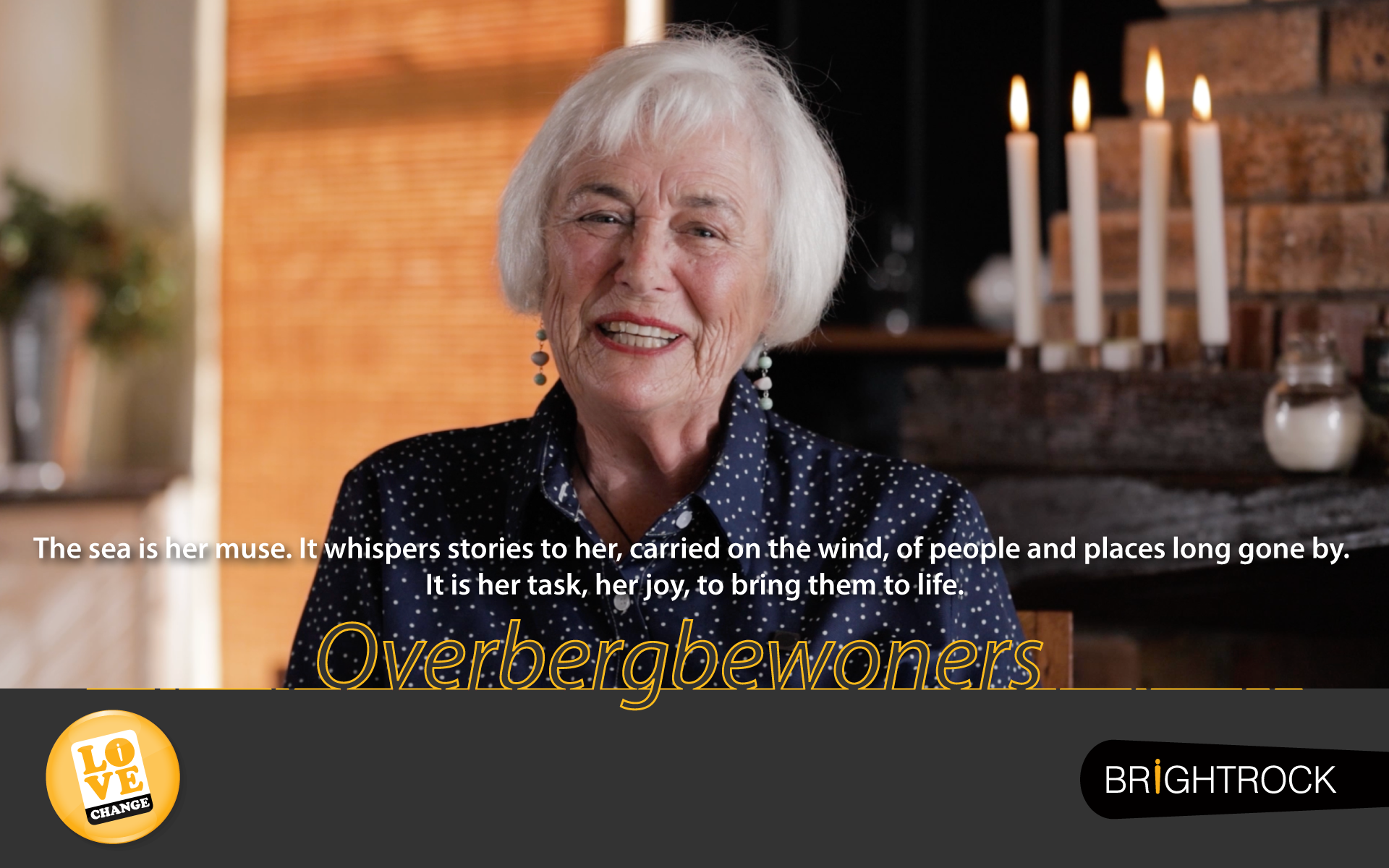
Early in the morning on the Strandveld, with the Atlantic breeze whipping up the sand and ruffling the fynbos, Sophie Fourie follows the well-trodden path to the shore.
At her side is her faithful rescue dog, Meisiekind, who loves the beach but keeps her distance from the water.
The waves unfurl before them, like the pages of a book.
The sea is a constant in Sophie’s life, the engine of an imagination that has turned her into one of South Africa’s most beloved storytellers.
The characters in her novels inhabit this windswept landscape – the dunes and shrublands, the sandstone cliffs, the rocks that clawed great ships to their doom – as fully as she does.
Sophie, who writes under the name SD Fourie, lives in a double-storey dwelling in Franskraal, near Gansbaai, where the wreck of the Birkenhead still rests in the deep.
From the window of her writing room, with its brick fireplace, cosy armchairs and crammed bookcases, she is blessed with a view that beckons her all the way back to her childhood.
She was born in an age of war and grew up in a place of peace. As a little girl on a farm called Vredehoek, not far from where she now stays, she would lie on her back and look up at the drifting clouds.
“I always believed that on the other side of the clouds, there were other worlds waiting to be explored,” she recalls. She was a dreamer, the first qualification for becoming a writer.
At school, in the koshuis, she was already earning money from her craft, writing essays for her friends for a small fee. “I made sure that their essays weren’t quite as good as mine,” she laughs.
One day, when she was 19, the world opened up for Sophie. She was cleaning the chimney of the old coal stove in the kitchen on the farm. It was a chore that left her dusted from head to toe with soot.
Jan “Pyp” Fourie, a teacher and friend of her father, came to visit.
“He walked into the kitchen and saw me there, sitting in the hearth like Cinderella,” says Sophie. “Later, he told me that was the moment he decided he would marry me.”
They were married for 55 years. “Cinderella stayed with her prince,” she says.
They made their home on the plot in Franskraal, underneath the milkwood trees. They wrote books on the history and attractions of the Strandveld together and ran a museum that included the largest collection of relics from the sinking of the Birkenhead off Danger Point in 1845.
Looking back on her life with Jan, who passed away in 2019, she reads the lines of a poem she wrote in front of the fire one wintry day.
“Ek het geen verwyt of spyt, oor jare wat verby is,” she begins. She has no regrets or reproaches about bygone years, for words spoken and words left unspoken.
She speaks of “kwaad gestook sonder rede, versplinterde vrede” – a shattered peace, anger stoked without reason.
Now the house is empty, and silence screams against the walls. “Nou ’n leë huis, met stilte wat gil teen die mure.”
But no regrets, no regrets, she says, echoing Edith Piaf: “dit was tog die moeite werd.” And still, every day, outside the window, she hears the ocean calling.
“The sea has movement,” she says, “and with the movement of the sea, it feels to me as if I never get older. As if I am always exactly the same age, because the sea is the same today as it was yesterday and will be tomorrow.”
She started her writing career — leaving aside her humble earnings as an essay scribe at school — as an occasional contributor of short stories to Rooi Rose and Huisgenoot. “I was besotted by the sight of my name in print.”
Her big break came in 2004, with her debut radio drama, Roep van die potjieriet, which earned her third place in the beginners section of an RSG competition.
Her first novel, Die Lanternswaaier, was a story of the Strandveld, a historical romance about a young woman who is forced by her father to carry a lantern to lure unsuspecting ships to the presumed safety of the shore. The heroine’s name was Sophie.
The novel was a runaway success, establishing SD Fourie as one of the taal’s most evocative writers. She has since written a further four novels. There is no lack of inspiration for many more, in the living history and the landscape around her.
“I sometimes think I could write until I am a hundred and fifty,” she says. “I don’t need to search for inspiration. It is around me, above me, beside me, within me. It is everywhere. It is my world.”
She knows the name of every bird and every flower in the Strandveld. She knows exactly when the Maartlelies bloom and when the seasons begin to shift.
“I grew up here,” she says. “I grew older here.” And then she quickly adds, “Although you’re not allowed to say that I’m old!”
When she looks back at all the words she has written, her purpose as a writer comes down to one thing only. “I walked back in order to know where I’m going.”
She has learned that emotions don’t belong to history. They remain the same, generation after generation.
“In my stories, people are not always good, but they grow. They become better by living. I don’t end in darkness. My characters don’t end in despair.”
This is the legacy she wants to leave, not just for her readers, but for her children.
“One day when I am no longer here, they can read my books,” she says. “That makes it easier for me. They are forgiving by nature.”
She laughs at the thought, and off she wanders again, with Meisiekind at her side – “She rules my life!” – to tread the well-trodden ground, to wonder at the sea and the mountains and the fynbos, and to explore the new worlds that lie beyond the drifting clouds.